

A good founder website tells a stranger what you do and who it's for within seconds, speaks to the buyer rather than about you, and gives every page one clear next step. It's the only digital asset you fully own, so it should carry the most weight.
The only thing on the internet that's actually yours
There's a version of your business that lives on someone else's platform. An Instagram account that could be suspended tomorrow. A Facebook page with terms that changed last year without much notice. A LinkedIn profile sitting on a server you'll never see. All of it real work. None of it yours.
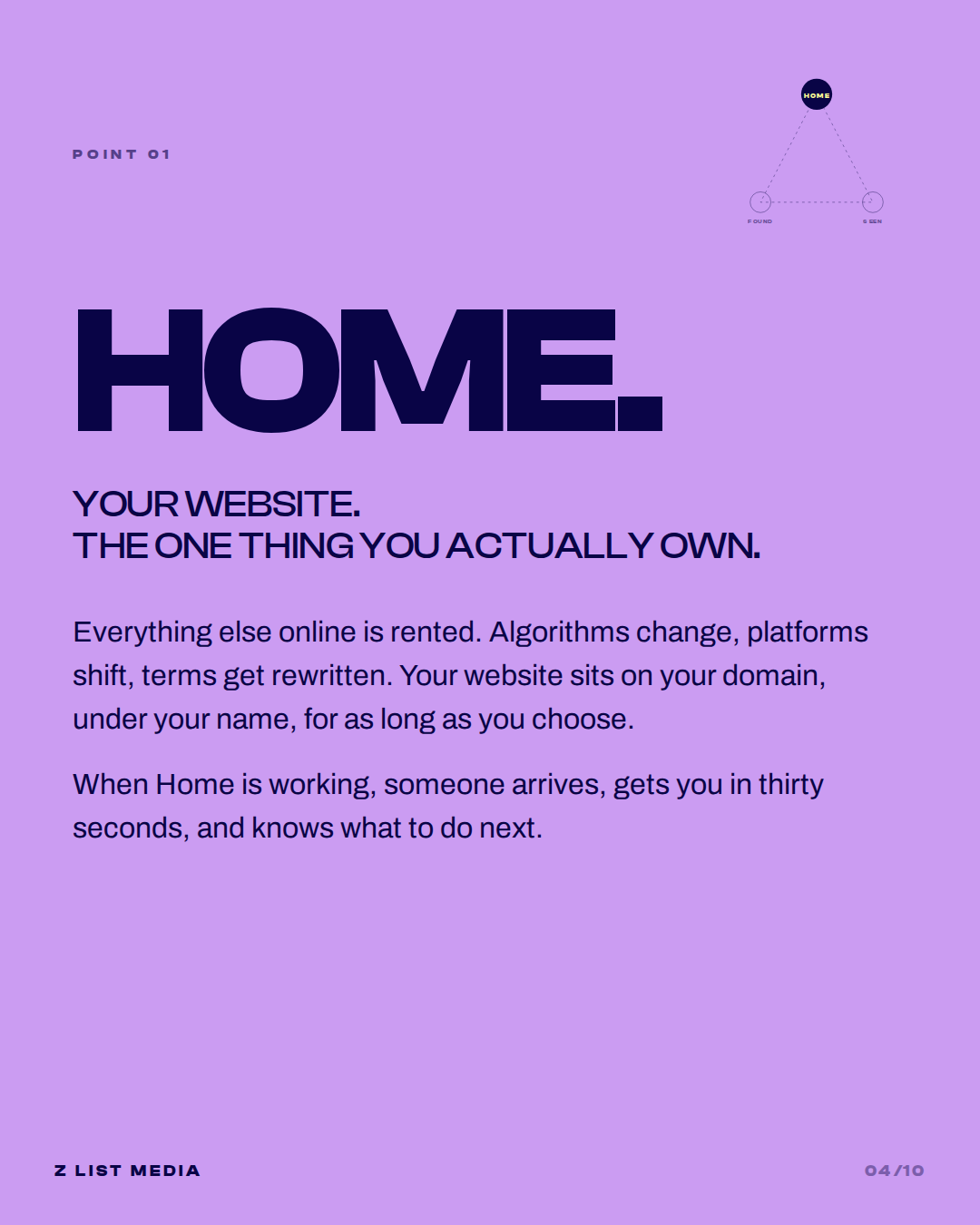
Your website is different. It sits on your domain, under your name, saying exactly what you want it to say, for as long as you choose. When you update it, it updates. When a platform changes its algorithm or its ownership or its rules, your website doesn't change with it. It stays yours.
This is why Home is the foundation of the Digital Triangle. Not because it's the most exciting side to work on, but because it's the one asset that compounds in your favour over time, and the one that's entirely under your control. Everything else is rented. The domain on your business card is the lease you own outright.
What does a good business website need to do?
A good website does three things. That's it. Three.
It tells a stranger, within the first thirty seconds, what the business is and who it's for. It makes the next step obvious, not something the visitor has to search for. It does both of those things in a voice that sounds unmistakably like you, not like a generic version of your industry.
Most websites underperform because they're trying to do more than three things at once. They're a portfolio, a blog, a sales page, a brand story, and a contact form all living on the same homepage. The result is a site that does all of those things adequately and none of them well.
A visitor arrives with one question: is this the right place for me? A good website answers that question on the first screen. Yes, this is the right place. Here's why. Here's what to do next. That's the entire brief. The clever copy and the beautiful photography earn their place once those three things are clear. Before that, they're just noise in the way of the answer.
Why isn't my website converting?
These are the four most common places I see websites losing the people they should be converting. Each one can shift, and none of them require a rebuild.
The homepage doesn't say what the business is for
The most common reason a homepage underperforms is the simplest one: it doesn't tell a stranger what the business does. Not in a way they can take in within thirty seconds, anyway.
It's not that founders don't know what they do. It's that they're so close to it they assume context a visitor doesn't have. The visitor arrives from a Google search or a friend's recommendation or a bio link, scans the opening paragraph, and needs to understand immediately what this is and whether it's for them. A homepage that answers that question without asking them to work for it converts. One that makes them dig for the answer tends not to.
Try this: look at your homepage opening as though you've never heard of your business. Does it tell you what the business does? If not, that's the sentence to write first, before anything else.
The next step isn't clear
If someone arrives on your site and wants to do something, can they easily? Not just find a contact form somewhere. Do the specific thing that moves the relationship forward: book a call, buy the offer, download the resource, join the list.
A homepage with one clear next step converts. A homepage with six possible next steps tends to see none of them taken. The question worth asking is: what's the one thing I want someone to do after landing on this page? Once you know the answer to that, make it the only thing pointing at them. Everything else can wait.
The copy is talking to the founder, not the buyer
There's a version of website copy that makes the founder feel good. It uses language the founder is proud of, describes the work the way the founder sees it, and positions the business the way the founder would like to be positioned. This works well if the founder is also the buyer. Most of the time, they're not.
The buyer wants to know what this does for them, how it addresses the specific thing they arrived with, and whether this person can be trusted to deliver. The way to find out if your copy is talking to the founder or the buyer: go through it from the buyer's perspective and count how many times you feel truly spoken to. If that number is low, that's the rewrite.
The site hasn't caught up with the business
Businesses evolve. Positioning sharpens. Offers change. The ideal client shifts as the founder gets clearer on who they do their best work with. The website, if it hasn't been touched in a while, is still describing the version of the business that existed before all of that.
This is worth updating not because the old site was wrong, but because it's describing something that's already out of date. Visitors land on a version of you that's behind where you actually are. The hard thinking is already done. The site just needs to catch up.
What this looks like at its best
A website that's doing its job feels effortless to the right person. They land, they take it in, they think: yes, this is what I was looking for. They know what to do next. They do it.
That effortlessness is the product of clarity, not complexity. The most effective websites I see aren't the most elaborate ones. They're the ones where somebody made a clear decision about who the site is for and what it's asking them to do, and built everything around that decision. One question answered well, one next step made obvious, one voice that sounds like a real person wrote it.
A sharp website works while you're at dinner. While you're on leave. While you're running a session with a client and not thinking about it at all.
This is the thing about Home that's easy to underestimate: it works whether you're showing up anywhere else or not. A piece of social content does that for about twenty-four hours. The website does it indefinitely. That's why getting it right is worth the time it takes.
Where to start
The place to start is a ten-minute walk-through of your current homepage as a stranger. Open it, go through it top to bottom, and ask three questions: do I know what this business does? Do I know if it's for me? Do I know what to do next?
If the answer to any of those is no or not quite, that's the work. Not a full rebuild. Not a rebrand. The three things: who you are, who it's for, what next. Sorted, in that order.
If you want a second set of eyes on it, the Once-Over is built for this: one page of yours, one honest look, plus where you're showing up in search and what to do about it, back to you as a clear PDF within four business days. The Digital Triangle PDF also has the prompts for working through Home at your own pace.
Home is one side of three
A sharp website converts the people who arrive. Getting them there in the first place is Found's job. Building enough trust that they're willing to click is Seen's job. All three pulling together is what makes a presence that works without you having to push it constantly.
More on the triangle:
- Found: how to be found online without posting every day
- Seen: one platform, done well
- Which side of your triangle needs the work
Questions about your website
What should a small business website do?
Three things. Tell a stranger within thirty seconds what the business is and who it's for, make the next step obvious, and do both in a voice that sounds like you rather than a generic version of your industry. Everything else earns its place once those are clear.
Why isn't my website converting?
The usual culprits are a homepage that doesn't say what the business is for, a next step that isn't clear, copy written for the founder rather than the buyer, and a site that hasn't caught up with how the business has changed. None of them need a rebuild.
Do I need a new website?
Rarely. Start with a ten-minute walk-through of your homepage as a stranger and ask: do I know what this business does, do I know if it's for me, and do I know what to do next? If any answer is no, that's the work, not a full rebuild.
Want to know where yours stands?
Start with a Once-Over. One page of yours, one honest look, plus where you're showing up in search and what to do about it. Back to you as a clear PDF within four business days.
Rather talk it through? Book a 45-minute call.
Book your Once-Over · $47 Book a 45-minute call