

The Digital Triangle is a way of looking at your online presence as three sides: Home (your website), Found (search, Google and AI answers) and Seen (social). Most founders are working one side hard and leaving the others. The side with the most room is usually where your next enquiries are hiding.
Where the room is
Most founders working on their digital presence are already doing the work. The calendar is running. Content is going out. The effort is real and consistent. What they're usually looking for isn't a reason to start. It's a clearer sense of where to focus next.
Not every part of a digital presence moves at the same pace or needs the same attention at the same time. Enquiries plateau. Traffic holds steady but doesn't climb. The clients you'd love to work with find you occasionally, but not reliably. The work is there. The question is where the most room is right now.
The Digital Triangle gives that question a clear answer. Three sides, each one doing a different job, each one connected to the other two. By the end of this, you'll know exactly which side to give your attention to next.
What is the Digital Triangle?
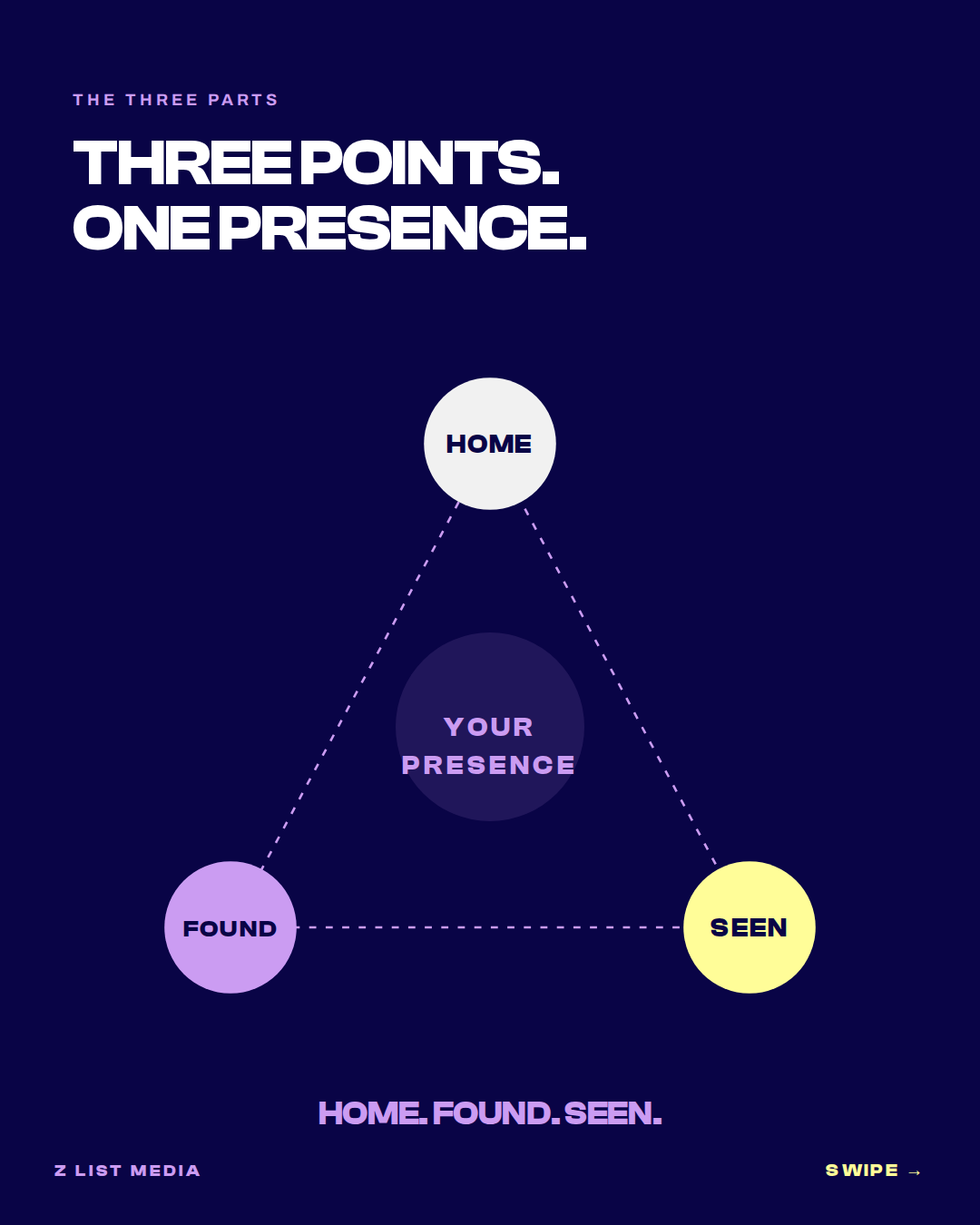
The Digital Triangle is the framework I use when I look at any founder's online presence. Three sides, each one doing a different job, each one connected to the other two.
Home is your website. It's the only piece of digital real estate you own outright, the one asset that doesn't disappear when an algorithm shifts or a platform changes its rules or an account gets suspended for reasons nobody can fully explain. Home is where you convert. The visitor arrives, takes it in, and decides within thirty seconds whether you're the right person for what they need. The whole brief for a good website is just that: be clear about who you are, who it's for, and what they should do next. Not clever for the sake of it. Unmistakably yours.
Found is how new people discover you when they're not already in your orbit. The most reliable version is search: Google, Pinterest, anything with a search bar that indexes your content. When Found is working, someone types a question they're already asking, your post comes up, they click through, and they find you. Found is the compounding side of the triangle. The post you write this month can still be sending people to your website in 2029. It takes longer to build than a reel. It works while you sleep, while you take time off, while you're busy doing everything else.
Seen is your real-time presence. Social media, newsletters, the places where people encounter you regularly without actively looking. Seen is how strangers become warm leads, how someone builds a clear sense of who you are before they've committed to anything. The channel matters less than the consistency. One platform, done well and without resenting it, outperforms five at half-strength every time.
Three sides. One presence. The work isn't doing more of any one of them. The work is getting all three moving in the same direction at once.
Which side of your online presence needs the work?
Most founders are actively working one point of this triangle, occasionally two. The question isn't what's wrong. It's where the room is. Here's how to size up each side.
Home
Three signs Home is your next opportunity
If your business has moved in the last year or two, the website is usually the last thing that catches up. You've repositioned, gotten clearer on who you're actually for, sharpened the offer. The site is still describing the version of you that existed before all of that. Visitors land on a version of your business that's already out of date. The hard thinking is done. The site needs to reflect it.
Here's a question worth asking once, right now: what is your homepage specifically for? Not what it has on it. What job is it doing? A homepage with a single clear purpose converts. One trying to cover everything tends to convert nothing in particular. Naming the job is a ten-minute exercise that can change how the whole page performs.
If you've got traffic coming in and the enquiries aren't quite following, the work is in the site rather than in more reach. More traffic to a page that isn't converting just amplifies the gap. Getting the site sharp first means everything else you do to bring people in starts pulling its weight. A Once-Over is built for exactly this: one page, one honest look, and what to do about it.
Found
Three signs Found is your next opportunity
If your warm network is working well, referrals coming in, people finding you through word of mouth, that's a really good thing. Found is the layer that sits alongside it, bringing in the people who don't know you yet but are already searching for what you do. The questions your ideal clients are typing into Google right now, looking for exactly what you offer, are currently landing somewhere that isn't you. That's worth doing something about.
If most of your traffic is referral-based or comes through your social bio, you've built something solid. There's also a whole channel of cold discovery sitting available alongside it. Found traffic is different in quality: those people arrived because they were already looking. They're usually further along than someone who stumbled across a reel. Building that channel is slower work, but the leads it produces tend to close faster.
If there's content on your site that hasn't been touched in a while, even modest attention to Found compounds over time in a way that no other channel does. The post you write this month can still be sending people to your site in 2029. That's the asymmetry most founders underestimate, and why Found is the most underused side of the triangle for founders who are otherwise doing everything right.
Seen
Three signs Seen is your next opportunity
If you're already showing up consistently and the growth has plateaued, it's rarely about posting more. The question is whether the content is building toward the audience you want or performing for the one you already have. That's a strategy question, not a volume question, and it's a much more interesting one to answer.
If most of the people engaging with your content are already in your orbit, warm and familiar, the next layer is content designed for the people right outside that circle. The ones who'd be a perfect fit if they knew you existed. Seen done well doesn't only maintain relationships. It builds new ones, on your terms, at your pace.
If you're spread across multiple platforms and finding it hard to show up well on any of them, consolidating is worth doing. One platform, chosen well and given full attention, outperforms five at partial effort every time. What frees up isn't only the time. It's the energy that's been going into showing up on channels that weren't working for you anyway.
The part that's easy to miss
Here's the bit that gets overlooked: the three sides don't work in isolation. The enquiry that lands in your inbox on a Tuesday isn't a Seen result or a Found result or a Home result. It's all three, working in sequence.
Someone found your blog post via a search six months ago. Came back to the website a few times. Started following you on Instagram. Took in enough of your content to decide you were the right fit. Then booked. Which side of the triangle gets the credit? All of them.
Found opened the door. Seen built the trust. Home closed the loop.
This is why sharpening only one side rarely produces the outcome founders are hoping for. The cleanest homepage in the world still gets no enquiries if nobody can find you and nobody knows who you are. A strong SEO foundation brings people in and watches them leave a site that doesn't convince them. A loyal social following has nowhere to go when they're ready to act because the site isn't built to receive them.
The Digital Triangle is useful because it names all three sides and asks for an honest look at what's there, not just the part that's been getting the attention.
Where to go from here
From here, two directions.
If one of the three sections landed for you, the spoke posts go deeper. Each one takes a single side into detail: what it is, what it looks like when it's working, and how to start. Pick the one that fits where you are right now.
- Home: your website is the one place you fully control
- Found: how to be found online without posting every day
- Seen: one platform, done well
If you're unsure which side to focus on, or if more than one resonated, the Founder Deep Dive works through all three in ninety minutes. I look at your specific Home, Found, and Seen, work out where the most room is, and you leave with one clear directive to start with on Monday. The triangle gets built one side at a time. The Deep Dive tells you which side that is.
Questions about the Digital Triangle
What is the Digital Triangle?
A framework for looking at a founder's whole digital presence as three connected sides. Home is your website, where people convert. Found is how new people discover you through search. Seen is your real-time presence on social media and in newsletters, where strangers become warm leads.
How do I know which side of my digital presence to work on?
Look for the signs. If traffic arrives but enquiries don't follow, start with Home. If most clients come from referrals and nobody finds you through search, start with Found. If you're posting consistently but growth has plateaued, or you're spread across too many platforms, start with Seen.
Why doesn't improving one side of the triangle work on its own?
Enquiries come from all three working in sequence. Someone finds a blog post through search, comes back to the website, follows you on Instagram, then books. Found opens the door, Seen builds the trust and Home closes the loop, so a gap in one side limits the other two.
Want to know where yours stands?
Start with a Once-Over. One page of yours, one honest look, plus where you're showing up in search and what to do about it. Back to you as a clear PDF within four business days.
Rather talk it through? Book a 45-minute call.
Book your Once-Over · $47 Book a 45-minute call