

For most founders, one social platform done well beats five done half-heartedly. Choose it with three questions: where your buyers actually spend time, which format matches how you naturally communicate, and which one you can keep up for years. Depth with the right people builds more trust than reach.
The advice everyone gets
Be everywhere your audience is. Post consistently. Show up every day. If one platform isn't working, try another. The implication being that the answer is always more.
This advice gets handed out freely and followed diligently by founders who then spend two years posting across five platforms, getting modest traction on none of them, and privately concluding that social media doesn't work for their kind of business.
Social media does work. The advice doesn't.
One platform, chosen because your buyers are actually there and because the format plays to how you naturally communicate, done consistently without resenting it every Tuesday, outperforms five at half-strength every single time. That's not a contrarian position. It's the thing I see week in, week out, in the businesses I work with. The question isn't whether to be on social. It's which one, and how to show up on it in a way that builds something real.
What is social media actually for?
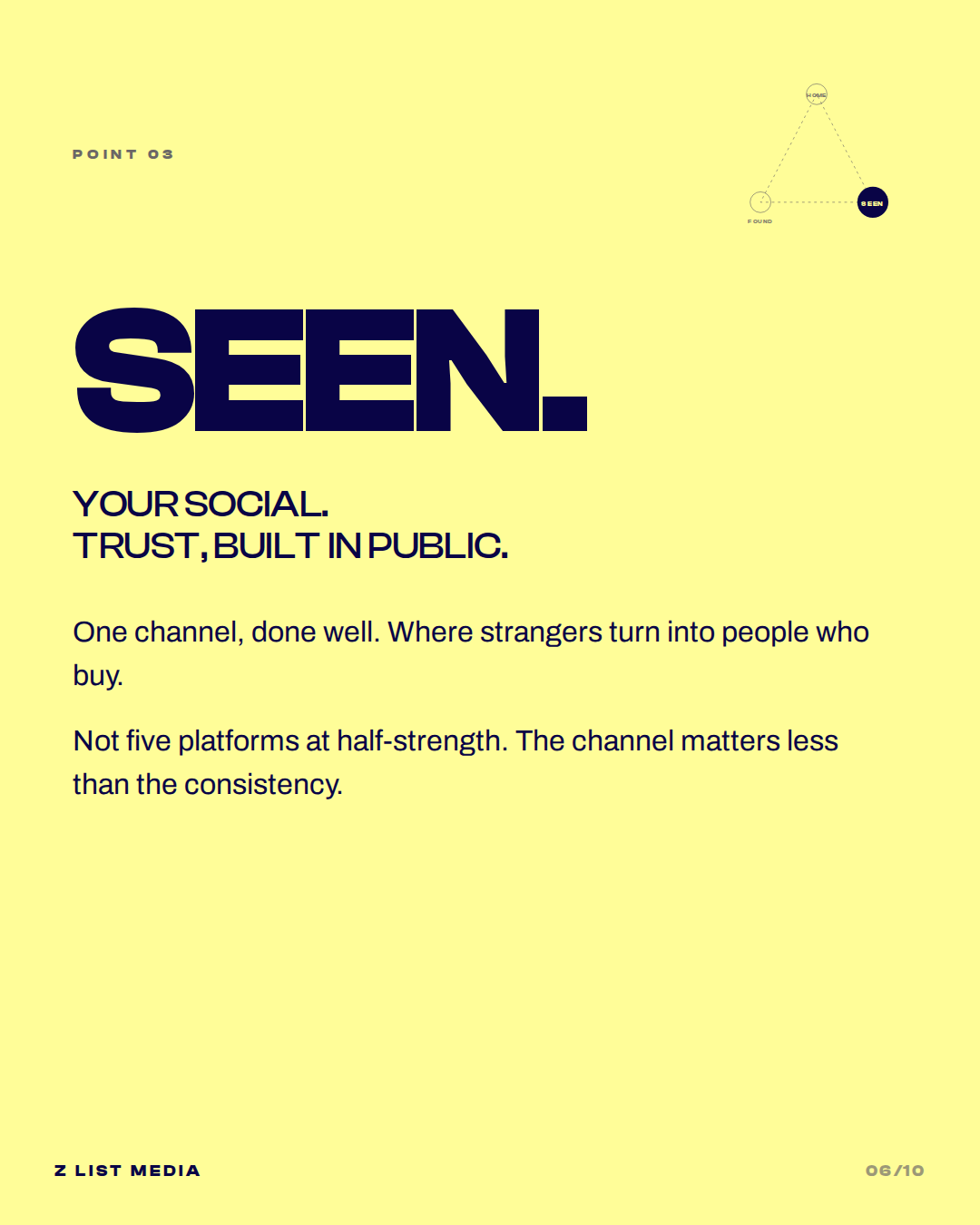
Seen is the trust-building side of the Digital Triangle. Its job isn't to go viral. It isn't to build a following for its own sake. It's to make the person who finds you, wherever they find you, feel like they already know you a little before they ever book anything.
That feeling, the one that sounds like "I've been following this person for a while, I know how they think, I trust their judgement," is what converts cold traffic into warm leads. It's what makes the difference between someone landing on your website and bouncing straight back out, and someone arriving and thinking: yes, this is the right person.
Seen does that work slowly and steadily, post by post, over time. It's not a direct sales channel. It's the relationship before the transaction. Understanding that changes what you post, how often you post it, and which platform actually makes sense for you. If the job is trust-building rather than reach, then depth matters more than volume, and the right audience matters more than a large one.
A hundred people who truly know what you do and trust you to do it is worth more than ten thousand who scrolled past your face once. That clarity makes a lot of the decisions much simpler.
Should a small business focus on one social platform?
Here's the maths. An hour a day across five platforms is twelve minutes per platform. An hour a day on one platform is an hour. The content you produce in twelve minutes is noticeably different from the content you produce in an hour. The relationship you build with twelve minutes of daily attention is noticeably thinner than the one you build with an hour.
Consistency compounds. Showing up on one platform well, week after week, builds something that showing up on five platforms occasionally simply doesn't produce. The algorithm rewards it. The audience recognises it. The trust accumulates in a way that scattered, reluctant appearances don't.
There's also an energy cost that doesn't appear in any time tracker. Every platform you maintain requires you to stay across its culture, its format norms, its current conventions. That's real cognitive overhead, and it drains energy that should be going into making the actual content good.
Two strong posts a week on the right platform outperform seven mediocre ones spread across five. Every time.
The founders with strong Seen sides that I see consistently are not the ones posting the most. They're the ones who made a clear decision about where to show up and then actually showed up there. That decision, made once and committed to, does more for a social presence than any content strategy built on the wrong platform.
How do you pick the right social platform?
Three questions. Answer all three honestly and the right platform tends to become obvious.
Where are your buyers actually spending time?
Not where you've been told they spend time. Not where someone with a large following said to be. Where are the specific people you're trying to reach, right now, actually spending their online attention? If you're not sure, the most useful thing you can do is ask the last three clients you loved working with where they spend time online. The answer is more useful than any generic platform advice, because it's specific to your actual buyers rather than a notional ideal audience.
Which platform's format matches how you naturally communicate?
Some people think in paragraphs. Some think in short punchy statements. Some are more comfortable talking than writing. Some would rather make something visual. The format question matters because the platform you can communicate in naturally is the one you'll show up on consistently. The one that requires you to become a different kind of communicator is the one you'll find reasons to avoid by the end of the month. Instagram rewards visual thinkers. Threads rewards writers. Podcasts reward talkers. None of those is better in the abstract. The right one is the one that fits how you actually work.
Which one can you show up on without resenting it?
This question sounds soft but it isn't. The platform you resent is the one you'll gradually stop showing up on. The posts get less frequent, the quality drops, the account goes silent. Resentment is a signal, not a character flaw. It usually means the format doesn't suit you, the audience isn't there, or the content it requires isn't content you want to make. All three shift when you choose differently. The platform where all three questions line up, where your buyers are, where the format suits you, where you can show up without it costing more than it returns, that's the one.
What good looks like
A Seen side that's working looks less impressive from the outside than most founders expect. It's two solid posts a week, consistently, over two years. It's a handful of posts that get saved and shared every few months. It's a comment section where people say things like "I've been thinking about this exact thing" or "I sent this to three people I know." It's an audience that's truly warm, even if it isn't especially large.
What it doesn't look like is daily posting and enormous reach and thousands of new followers each month. Those things can exist alongside a strong Seen side, but they're not the goal. The goal is warm, trusted, known. The kind of known where someone lands on your website having already decided you're the right person, and the homepage is really just confirming what they already felt.
The founder who's been showing up on one platform for two years, posting the things she actually thinks, in her actual voice, for the people she actually wants to work with, will outperform the founder grinding out content across five platforms every day. The first one is building a relationship. The second one is broadcasting into the void and wondering why nothing is sticking.
Seen is one side of three
Seen builds the trust that makes people click. Found brings in the people who haven't heard of you yet. Home converts them once they arrive. All three working together is what makes a presence that grows without requiring you to be everywhere at once.
More on the triangle:
- Home: your website is the one place you fully control
- Found: how to be found online without posting every day
- Which side of your triangle needs the work
Questions about social media focus
Should my business be on every social media platform?
No. One platform chosen because your buyers are there and the format suits how you communicate, used consistently, outperforms five at half-strength. An hour a day on one platform builds a deeper relationship than twelve minutes on each of five.
How do I choose one social media platform for my business?
Ask three questions. Where are your buyers actually spending time? Ask your last three favourite clients. Which platform's format matches how you naturally communicate? Which one can you show up on without resenting it? Where all three line up is your platform.
What does a good social media presence look like for a small business?
Less impressive from the outside than most expect: two solid posts a week, consistently, over a couple of years. A handful of posts that get saved and shared, comments from people who feel seen, and an audience that's warm rather than large.
Want to know where yours stands?
Start with a Once-Over. One page of yours, one honest look, plus where you're showing up in search and what to do about it. Back to you as a clear PDF within four business days.
Rather talk it through? Book a 45-minute call.
Book your Once-Over · $47 Book a 45-minute call