ChatGPT and other AI tools mostly name local businesses they can confirm from four places: your own website, plenty of recent Google reviews, the Google map pack and a complete Google Business Profile. Pages on your own site that answer real client questions in plain language do the most work.
Someone opens ChatGPT and asks for a bookkeeper, a physio, a photographer near them. It gives them three names and a line about each. That conversation happens without you in the room, and you are either one of the three or you are nowhere in it.
A year ago this was a curiosity. It stopped being one somewhere around March.
How many people use AI to find a local business?
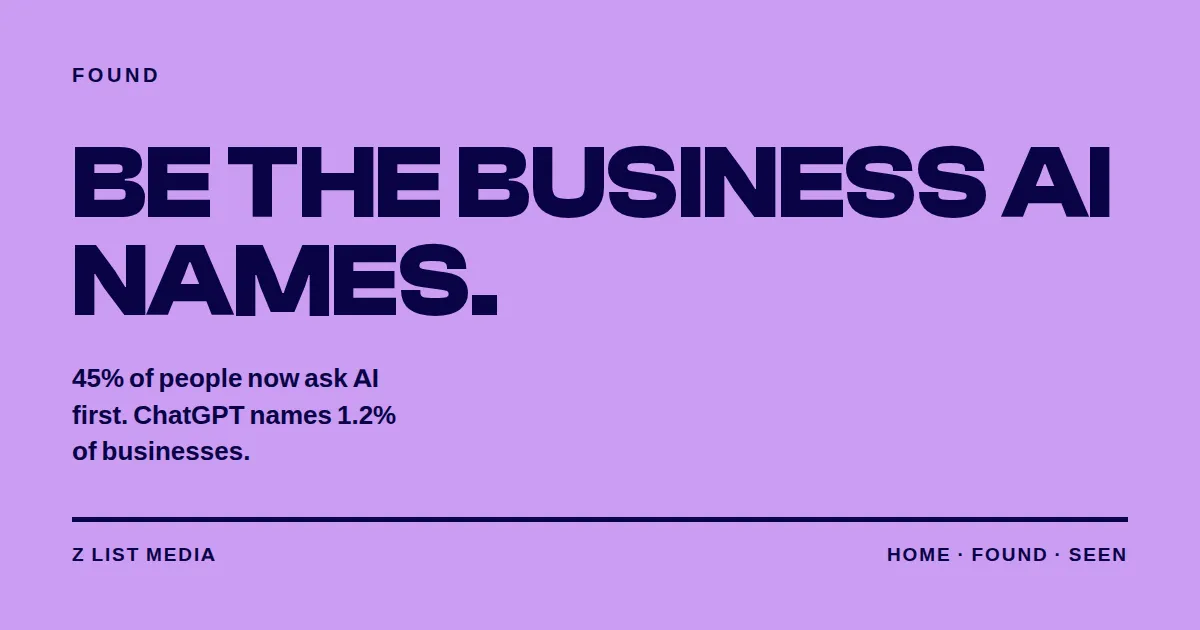
BrightLocal has consumers using AI to find local businesses at 45 per cent, up from 6 per cent the year before. That is not a trend line, it is a cliff, and we are standing at the bottom of it looking up.
ChatGPT leads at 31 per cent, Google AI Mode sits at 23 per cent. The heaviest users are 30 to 44 year olds at 64 per cent, which is most of the people with money to spend on what you sell. Trust is there too: 63 per cent of the people using it trust what it tells them.
How often does ChatGPT name a small business?
SOCi audited more than 350,000 business locations across 2,751 brands. ChatGPT recommends 1.2 per cent of them. In hospitality it is starker, with 83 per cent of restaurants not appearing in AI recommendations at all.
Then there is the other half of it, from a separate study of 10,000 local businesses by Insites. AI knows 93 per cent of them exist. Only 55 per cent have accurate details. For nearly half of those businesses, the machine is confidently telling people the wrong thing about them right now.
What gets a business named by AI?
Insites went across more than 200 signals on ChatGPT and Perplexity to see what separated the businesses being recommended from the ones that were invisible. Four things carried it.
1. Your own website, ahead of everything
The single biggest source was the business's own site, cited in 72 per cent of awareness queries. Not directories, not social, yours. Visible businesses had roughly double the pages of invisible ones, and their sites had been updated more recently.
So the pages you keep meaning to write are the exact material the machine is working from. Every real question you answer in plain language is another thing it can say about you with confidence.
2. Reviews, in serious volume
Businesses visible on both platforms averaged 133 Google reviews. The invisible ones averaged 11. That gap is wide enough to be uncomfortable, and it is the most actionable thing in the whole study.
3. Being in the map pack
Businesses appearing in the local pack got 3.5 times more AI recommendations. The two systems feed each other, so the work you do on local search pays twice.
4. A finished Google profile
Profile completeness correlated strongly with visibility. The same free thing that was already worth doing is now worth doing twice over.
What did not matter
Core Web Vitals, page speed, structured data, and the AI-specific tactics currently being sold hard, including llms.txt files. No meaningful correlation, any of it. Which is the best news here: this is not a technical arms race you have already lost. It is the ordinary work, done consistently.
Being named is the start, not the finish
Here is the part that changes what you do with all this. People do not take the recommendation and act on it. Some 88 per cent of AI users fact-check what they are told, with 51 per cent going to verify the reviews and 37 per cent checking the source.
Only 18 per cent will contact a business off an AI recommendation without looking further. The rest go back to Google, at 43 per cent, or straight to your social, at 39 per cent.
So the machine names you, and then they go and look at your profile, your reviews and your grid. The whole chain only pays if the next link holds, which is why the Google profile and a live run of reviews are doing more work than they were even a year ago.
Where to start
Write the pages that answer what you get asked on every enquiry call, in the words people actually use. Keep the site current, because freshness showed up as a real signal. Get reviews moving and keep them moving. Finish the Google profile.
None of that is new advice. It is the same advice, and it is now load-bearing in a second place.
Questions I get asked
Do I need a different approach for ChatGPT than for Google?
Largely no, which is the relief in all this. The signals that made businesses visible to AI were the ordinary ones: a website with real depth, a finished Google profile, reviews in volume, presence in the map pack. Do that work once and it pays in both places.
Are the AI visibility tools worth paying for?
The Insites study looked at over 200 signals and found no meaningful correlation for the AI-specific tactics being sold right now, including llms.txt files and schema tricks. Your money does more on reviews and on pages that answer real questions.
How long before any of this shows up?
Slower than ads and faster than you'd think. Review volume and site freshness both moved the needle in the study, and they're the two things you can start affecting this week. Give it a quarter of consistent effort before you judge it.